The Simple Math Behind Annual Billing
Services offer annual billing for a simple reason: guaranteed revenue. In exchange, they pass some of that predictability back to you as a discount. The savings typically range from 15% to 40% depending on the category — VPNs and fitness apps tend to offer the steepest discounts, while cloud storage providers tend to be more conservative.
On its face, paying less per month sounds like an obvious win. But annual billing introduces a subtle psychological risk: the sunk-cost effect. Once you've paid for a full year, you may continue using a service not because it's valuable, but because you feel compelled to "get your money's worth."1 That inertia can keep you subscribed to services you've outgrown — which is fine when the service is cheap, but costly when it isn't.
The decision really comes down to two variables: how much you'll save, and how confident you are you'll use the service for the full twelve months. Get those two numbers right, and the right choice is usually obvious.
The Break-Even Formula
Before committing to an annual plan, run this single calculation. Divide the annual price by the monthly price to find your break-even point — the number of months you need to use the service before the annual plan starts saving you money.
If you're confident you'll use the service for longer than the break-even point, the annual plan wins outright. If you're uncertain — if there's a real chance you'll cancel before that point — the monthly plan preserves your flexibility and may actually cost you less in the long run.
Most services have break-even points between 7 and 10 months, meaning you need to stay subscribed for roughly 70–80% of the year before annual billing becomes advantageous. The shorter the break-even, the lower the risk of going annual.
Tip: If you've been on a monthly plan for more than 9 months without canceling, annual is almost always the better deal. Usage history is your best predictor of future use.
Annual vs Monthly: Real Numbers by Category
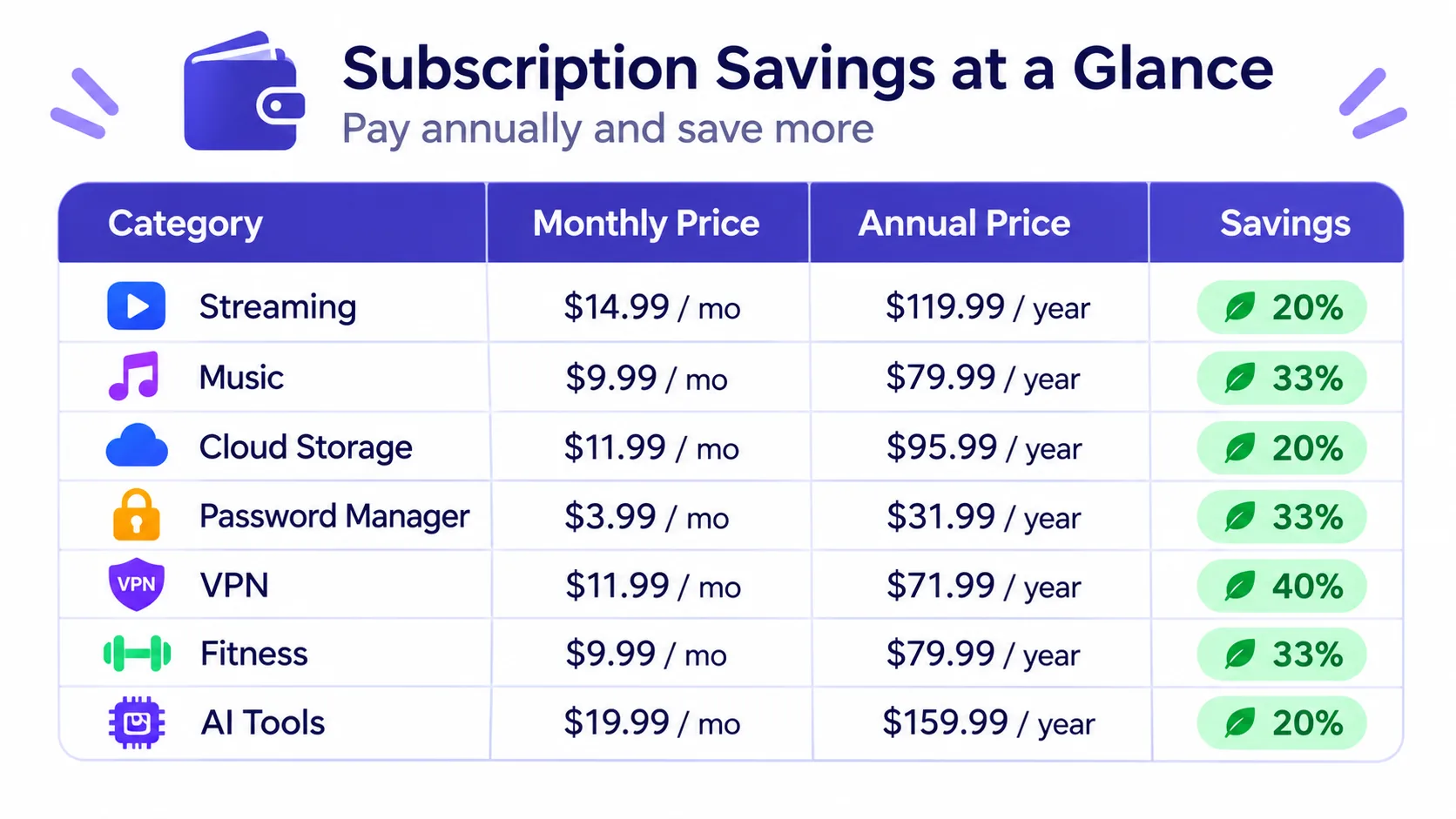
| Category | Monthly | Annual | Savings | Break-even |
|---|---|---|---|---|
| Streaming video (standard) | $15.49/mo | $139.99/yr | Save $45.89 | 9.0 months |
| Music streaming | $11.99/mo | $99.99/yr | Save $43.89 | 8.3 months |
| Cloud storage (2 TB) | $9.99/mo | $99.99/yr | Save $19.89 | 10.0 months |
| Password manager (family) | $4.99/mo | $35.88/yr | Save $23.99 | 7.2 months |
| VPN | $12.99/mo | $59.99/yr | Save $95.89 | 4.6 months |
| Fitness app | $14.99/mo | $79.99/yr | Save $99.89 | 5.3 months |
| AI / productivity tool | $20.00/mo | $200.00/yr | Save $40.00 | 10.0 months |
Prices are illustrative ranges based on common market rates 2024–2025. Check current pricing before committing.
When Annual Billing Makes Sense
The strongest case for annual billing is when you're already deeply embedded in a service. If you use a streaming platform every week, rely on a password manager daily, or depend on cloud storage as your primary backup — you're not going to cancel. Paying annually simply converts that certainty into savings.
Research on streaming subscriber behavior confirms this pattern: viewers who maintain a subscription for more than two consecutive months show dramatically lower churn rates, suggesting that the "will I keep it?" question resolves itself quickly.2 If you've already crossed that threshold on monthly billing, the incremental commitment of an annual plan is minimal — and the savings are real.
Annual billing also makes sense for services with stable, evergreen content — tools, utilities, cloud storage, and productivity apps that you use regardless of what's on the content calendar that month. These are the subscriptions where you'd stay monthly indefinitely anyway, and the annual discount is essentially free money.
When Monthly Billing Makes Sense
The core argument for monthly billing is flexibility. If your needs are seasonal, project-based, or genuinely uncertain, locking in twelve months of payments can be a poor trade even when the per-month price is lower.
This logic is especially compelling for content-driven services. Streaming platforms and content libraries have notoriously rotating catalogs — subscribers often sign up for a specific show or film, then cancel once they've watched it.3 If that's your pattern, the annual plan's savings evaporate the moment you cancel at month three.
Monthly billing also makes sense when you're evaluating a new service. Committing to twelve months before you understand your actual usage patterns is the fastest way to overpay. Spend two to three months on monthly billing, track how often you actually use the service, then run the break-even formula with real data.
The Decision Grid
Use this grid to make the call quickly. If most of your situation lands in the left column, go annual. If it falls in the right column, stay monthly until the uncertainty resolves.
✓ Pay annually when…
- You haven't considered canceling in 6+ months
- You use the service at least once per week
- The service fills a stable, ongoing need
- The break-even point is under 9 months
- It's a family plan shared across multiple people
✗ Stay monthly when…
- You signed up less than 3 months ago
- Your usage has been dropping recently
- You need it for a specific project or season
- You're using it for rotating or finite content
- You're still evaluating it against a competitor
Traps to Watch For
The sunk-cost trap
Paying annually can lock you into a service you've stopped finding valuable. If you notice yourself using an app only because "I already paid for the year," that's the sunk-cost effect at work. The money is gone regardless — the relevant question is whether the service is worth your time and attention today, not what you paid for it in January.
Annual plans that auto-renew silently
Annual subscriptions are the most likely to catch you off guard at renewal. Because there's a full year between charges, it's easy to forget you ever signed up. Set a calendar reminder 30 days before your renewal date the moment you subscribe annually. That 30-day window gives you time to evaluate, negotiate, or cancel without scrambling at the last minute.
Discounted annual plans for services you don't yet trust
A 40% discount on an annual plan sounds compelling — but not if you've been using the service for less than a month. Resist the pressure to lock in a long-term commitment before you have real usage data. Wait at least two to three months, confirm the service actually fits your workflow, then consider switching to annual. The discount will still be there.
Never miss an annual renewal
Subsee tracks all your subscriptions — monthly and annual — and reminds you before every renewal. Free for iPhone, iPad, and Mac.
Download Subsee — FreeFrequently Asked Questions
Can I switch from monthly to annual mid-cycle?
Most services allow you to upgrade from monthly to annual at any time. The typical approach is to credit the remaining days on your monthly plan against the annual price, so you only pay the difference. Check your account settings or contact support to confirm the exact policy — some services apply the upgrade immediately, others wait until your next billing date.
What happens if I cancel an annual subscription early?
Refund policies vary widely. Some services — especially those sold through the App Store or Google Play — offer prorated refunds for the unused portion of an annual plan. Others have a 30-day refund window but nothing after that. A few offer no refunds at all. Before committing to an annual plan, check the cancellation and refund policy. If the policy is unclear, that's itself a signal to stay monthly.
Are annual plans worth it for family plans?
Family plans amplify the savings math in two ways: the per-person monthly cost is already lower, and the likelihood that at least some family members will use the service year-round is high. If even two or three members of your household use a service regularly, an annual family plan is almost always the better value. Run the break-even calculation per person — if most family members cross the break-even threshold, the annual plan is a clear win.
References
- Arkes, H. R., & Blumer, C. (1985). The psychology of sunk cost. Organizational Behavior and Human Decision Processes, 35(1), 124–140.
- Spangler, T. (2024). Streaming churn: Why subscribers stay and when they leave. Variety.
- Zuora. (2024). Subscription Economy Index. Zuora Inc.
- Consumer Reports. (2023). Subscription services: What Americans pay and what they forget they're paying for. Consumer Reports.